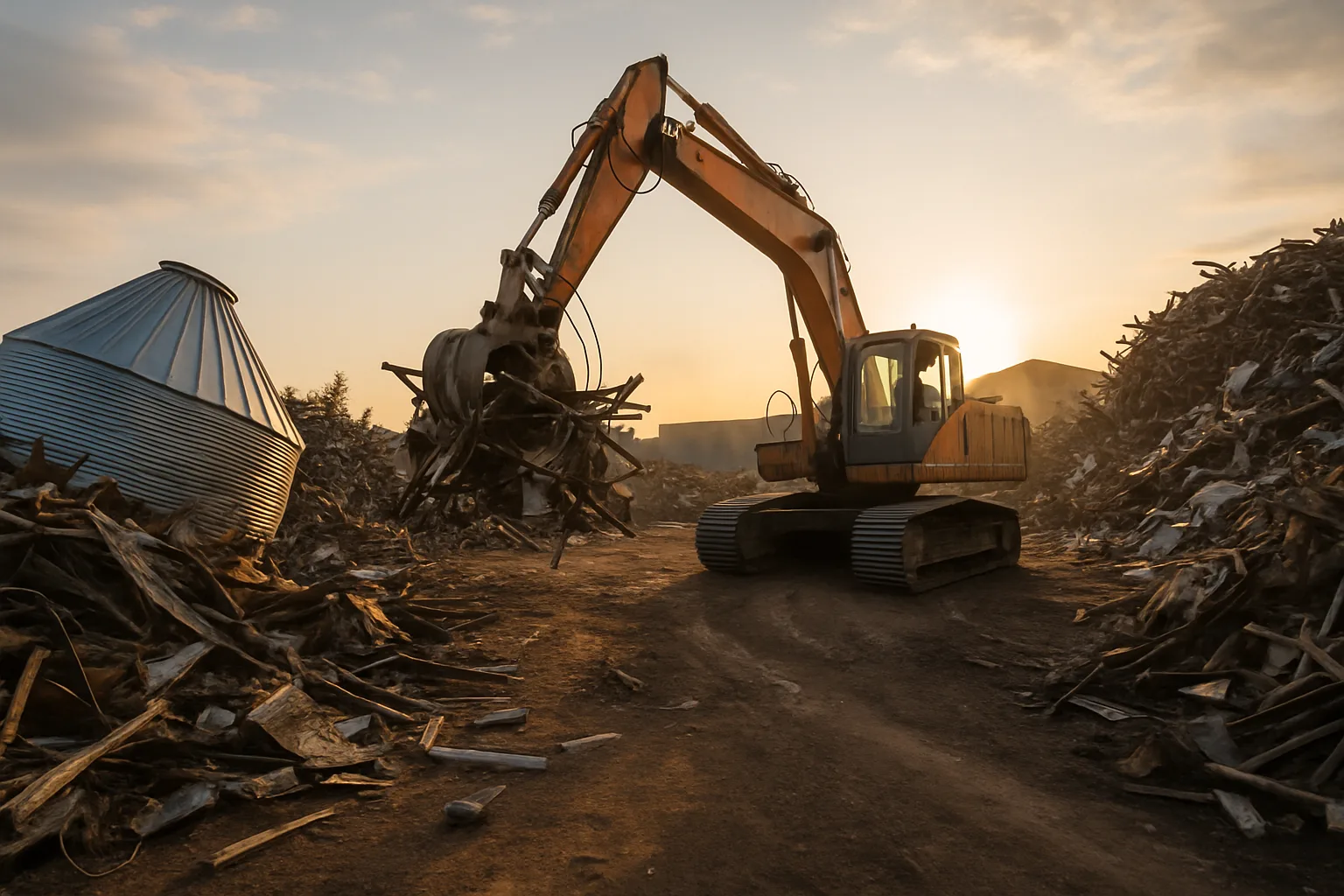
What to Do With Old Steel Grain Bins in Saskatchewan (Before They Cost You More Than They're Worth)
There are thousands of decommissioned grain bins sitting on Saskatchewan farms right now. Some are rusted through. Some were damaged in storms. Some were simply replaced with bigger, better storage. Whatever the reason yours is still standing there — or lying in pieces in the back forty — it represents real weight in steel, and real money if you handle the removal the right way.
Grain bin removal isn't the same as hauling away a broken tractor or a stack of old rim rounds. These are large-diameter steel structures, often bolted or welded, ranging from small on-farm hopper bins to massive commercial ring tanks. Getting rid of them takes planning, the right hauler, and someone who actually knows what they're looking at when they show up to your yard.
This guide breaks down how to dispose of old grain bins in Saskatchewan — and how to make sure the steel works for you, not against you, when it's time to move on.
Why Old Grain Bins Are a Real Scrap Metal Opportunity
Steel is steel. An old 2,000-bushel bin holds a significant amount of sheet metal — we're talking several tonnes depending on the gauge and size. That's recoverable material with market value, whether the bin is standing upright or already collapsed. Before you write it off as a demolition headache, consider what you actually have on your hands.
The wall sheets on most Prairie-built bins are corrugated galvanized steel. Galvanized scrap commands a reasonable price in the ferrous market, especially in volume. The roof sheets, centre bolts, base rings, and aeration floor components all add to the overall weight. A full-sized commercial bin teardown can yield enough material to make a bulk scrap load worthwhile — which is exactly where free pick up for qualifying loads comes into play.
- Standard round steel bins: Corrugated galvanized sheet metal wall panels, typically 14 to 16 gauge
- Hopper-bottom bins: Add the steel cone and support legs to the total recoverable weight
- Commercial flat-bottom tanks: Heavier gauge steel, significant tonnage per structure
- Aeration systems: May include copper or aluminum wiring and fan motors — non-ferrous components worth separating
That last point matters. If your old bins have electric aeration fans or wiring runs still attached, those copper-bearing components are worth more than the steel around them. Don't bury them in the load — flag them for separate pricing when you schedule your scrap metal pick up in Saskatchewan.
How Grain Bin Demolition and Removal Actually Works
Let's be direct about this: taking down a standing grain bin is physical work and it involves real safety considerations. You're dealing with large sheet metal panels that can shift, edges that are sharp, and structures that don't always come apart cleanly after years of corrosion and prairie wind. Don't start without a plan.
Here's how most farm bin removals go in practice:
- Assessment: Walk the structure. Is it standing or down? Are the bolts accessible or rusted solid? Is there grain residue, aeration hardware, or other material still inside?
- Disconnect utilities: If the bin has any electrical connections to aeration systems, fans, or grain monitoring equipment, disconnect and de-energize everything before work starts.
- Clear the interior: Remove any remaining grain, grain dust, or organic debris. This affects the scrap weight and the safety of anyone working around the structure.
- Disassembly: Larger operations use a crane or skid steer to assist. Smaller bins can be unbolted panel by panel. The rings come apart in sections once the roof is removed.
- Sorting and staging: Separate galvanized steel panels from any stainless, aluminum, or copper-bearing components before loading. This step protects your payout.
- Load and haul: Flat sheets and loose steel load efficiently. Most qualified bulk haulers can handle this in one or two runs depending on total volume.
If your bin is already collapsed or storm-damaged, the disassembly step gets faster — but sorting gets messier. Either way, the steel value is still there. Platforms like SMASH Recycling help connect Saskatchewan farm operations with buyers who understand bulk ferrous loads and can price them competitively through an auction format rather than a single phone call to one buyer.
Grain Bin Scrap and Junk Car Removal Regina: More Connected Than You Think
Here's something that surprises a lot of people: the same Saskatchewan farm that has three old grain bins to remove often has two or three scrap vehicles parked in the trees nearby. Old trucks that haven't moved in a decade. A combine cab going to rust. A half-ton that gave out before it was worth fixing.
Junk car removal Regina and surrounding rural areas is part of the same conversation as farm equipment and bin removal. When you're already doing a major cleanup of your yard or acreage, it makes sense to stage everything that needs to go and handle it in one coordinated pickup. That's where bulk scrap loads become cost-effective for everyone.
Our Regina scrap metal services extend well beyond the city limits. We run routes into the rural municipality corridor around Regina and out into the agricultural communities that sit within practical haul distance. If you're on a farm near Moose Jaw, Indian Head, Lumsden, or anywhere in the Regina Plains area, that's within scope for a coordinated farm scrap removal.
Scrap vehicles bring their own value to the equation. An old farm truck carries ferrous steel in the body and frame, aluminum in the engine block and transmission, and potentially a catalytic converter that has residual platinum-group metal content. Don't assume a vehicle that won't start is worthless — the components tell a different story. Cash for scrap cars Regina is a real conversation worth having before you haul your own vehicles to the metal yard yourself.
What Qualifies for Free Pick Up — and What Doesn't
We don't hide the ball on this. Free pick up for qualifying loads means exactly that — there's a threshold. We cover the cost of dispatch and hauling when the load is large enough to justify the run, and we're upfront about that from the first call.
What typically qualifies for free scrap metal pick up across Saskatchewan:
- Multiple grain bins or a single large commercial bin with significant tonnage
- Farm equipment cleanups — old tractors, implements, augers, combines, harrows
- Multiple scrap vehicles (2+) staged and accessible in one location
- Commercial or industrial volumes of structural steel, pipe, or fabricated metal
- Trade quantities of copper wire, pipe, or cable from electrical or HVAC jobs
- Oil field scrap — pipe, tubing, wellhead components, tanks
What may involve a pickup fee or be better suited to drop-off:
- Single appliances or small quantities with no other material to consolidate
- Individual scrap items in locations that require significant additional travel off a route
Items must be outside, in a yard, shed, or otherwise accessible. We do not enter private homes. If you're unsure whether your load qualifies, make the call and describe what you have — we'll tell you straight. You can also read scrap metal pick up guides for Saskatchewan to understand how loads are typically assessed before scheduling.
The Non-Ferrous Angle: Don't Leave Money in the Field
Grain bin removal tends to be thought of as a steel job — and it mostly is. But farm operations accumulate non-ferrous material in ways that often go unnoticed until someone starts actually pulling things apart.
Old aeration fan motors contain copper windings. Wiring runs to bins and grain monitoring systems use copper wire. Electric heat cables, control panels, and sensor wiring all add up. If you have a larger yard with multiple bins and a central electrical service to the grain handling area, there may be a meaningful amount of copper-bearing material embedded in what looks like just another scrap steel job.
Separating non-ferrous from ferrous before loading is always worth the extra time. Copper wire that gets buried in a load of galvanized steel panels doesn't disappear — but it doesn't get priced as copper either. It gets averaged into the mixed load rate, which is lower. Pulling it out and pricing it separately is straightforward if you're organized before the hauler arrives.
SMASH handles non-ferrous through a vetted buyer network with a competitive auction format — not a single buyer quoting you a number with no comparison point. More buyers seeing your copper-bearing material means better price discovery. That's how the system is supposed to work, and it's what platforms like list your scrap for pickup on SMASH Recycling are built around.
Planning Your Grain Bin Removal: A Practical Checklist
If you're ready to move forward with a grain bin removal in Saskatchewan this season, here's a practical pre-removal checklist to make the process go smoothly and maximize what you get out of it:
- ✅ Identify all structures to be removed — count the bins, note sizes and condition
- ✅ Check for any remaining grain, equipment, or hazardous material inside
- ✅ Disconnect and de-energize any electrical connections
- ✅ Flag and separate non-ferrous components before disassembly begins
- ✅ Note any scrap vehicles or additional equipment to consolidate into the same haul
- ✅ Confirm access — can a flatbed or haul truck reach the location?
- ✅ Contact a qualified hauler and describe the full scope — bin count, total estimated tonnage, vehicle count, and any non-ferrous
The more information you have ready before the first call, the faster you get an accurate assessment and a scheduled pick up. For scrap metal pick up across Saskatchewan, that planning step is what separates a smooth farm cleanup from a slow, expensive one.
Frequently Asked Questions
Q: Does junk car removal in Regina include farm trucks and old rural vehicles?
Yes. Junk car removal Regina covers everything from city driveways to rural acreages and farm yards. If you have old trucks, cars, or farm vehicles that haven't moved in years and are staged in an accessible location, we want to hear about it — especially when there are other scrap materials to consolidate in the same run.
Q: How much is my old grain bin worth as scrap steel?
Steel prices fluctuate based on market conditions, so we don't publish fixed prices here — and you should be cautious of anyone who quotes you a guaranteed price without seeing the load. What we can tell you is that bin weight, gauge, condition, and whether non-ferrous components are separated all affect the final value. Get a proper assessment based on what you actually have. Disclaimer: scrap metal prices change regularly — contact us for current rates.
Q: Can you pick up scrap from a farm outside Regina — for example, an RM in the surrounding area?
Absolutely. We service rural Saskatchewan including the RM areas surrounding Regina. Qualifying loads on farm properties, including bin removal, old equipment, and scrap vehicle removal, are within scope. Call us and describe your location and what you have — we'll let you know if the load qualifies for free pick up.
Q: What happens to the concrete pad after the bin is removed?
Concrete pads from grain bins are not part of our scrap metal pickup service — we haul steel and metals. Many farmers repurpose the existing pad for equipment storage or have it broken and removed separately through a local excavator or concrete recycler. Focus the scrap conversation on the metal components.
Q: Is there a cost for grain bin removal if the load qualifies?
Free pick up applies to qualifying loads — bulk steel volume, multiple vehicles, or significant non-ferrous material. If you're removing one small bin with minimal other material, there may be a pickup fee or drop-off may be a better option. We're transparent about this upfront. Just describe your full scope when you call and we'll give you a straight answer.
---If you're sitting on old bins, farm equipment, and scrap vehicles across a Saskatchewan yard this summer, now is a practical time to move on it before another season passes. Whether you're near Regina or farming three hours out, a well-staged bulk scrap load can be picked up at no cost for qualifying volumes. Call 1-855-SMASH-74 or visit scrap-metal-pick-up.com to describe what you have and get a real answer about pickup. Trades are always welcome — we pay top dollar for copper-bearing products from electrical, HVAC, and plumbing jobs.
Follow SMASH on LinkedIn at linkedin.com/company/scrap-metal-auction-sales-hub for scrap metal market updates, pricing trends, and industry news across North America.