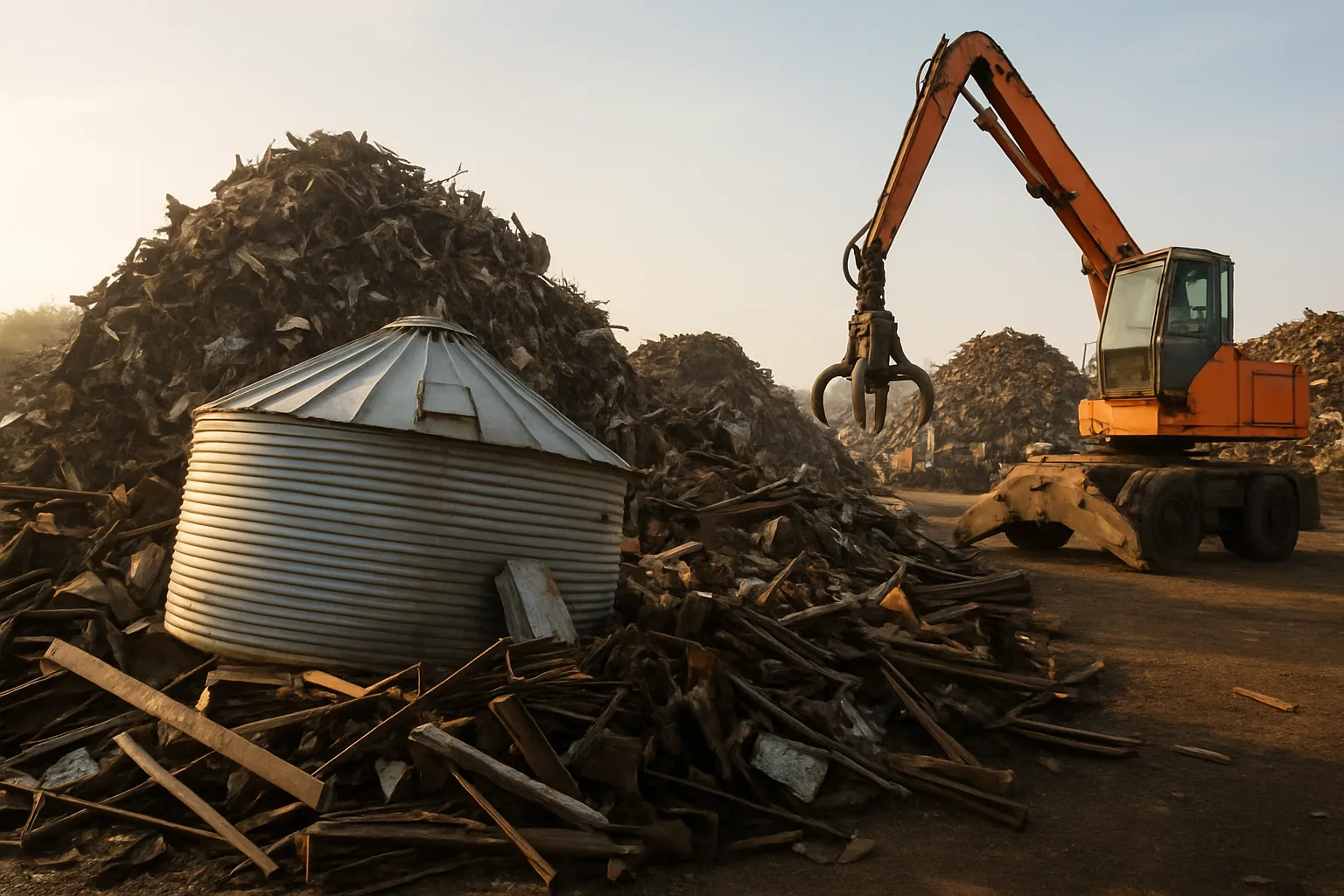
A single 5,000-bushel grain bin contains roughly 1,500 to 2,500 pounds of steel. Now multiply that by the six, ten, or fifteen bins sitting abandoned on your farmyard — and you're looking at a serious amount of recoverable metal that's just rusting in place.
Grain bin removal is one of the bigger farm cleanup jobs in Saskatchewan, and most farmers put it off because they're not sure where to start. Do you dismantle it yourself? Hire someone? Can you actually get paid for the steel? The answers depend on the condition of your bins, your location, and how you handle the logistics — but the short version is: yes, old steel bins have real scrap value, and there are ways to get them removed without it costing you a fortune.
This guide breaks down your options for scrap metal recycling Regina and across rural Saskatchewan — including what grain bins are actually worth, how removal typically works, and how platforms like SMASH connect farm sellers with serious buyers who compete for bulk loads.
Why Grain Bin Removal Is a Bigger Deal Than Most Farmers Expect
Old grain bins don't just look bad on a farmyard. They become liability. Collapsed or leaning bins are a safety hazard for workers, kids, and anyone else on the property. They attract pests. They trap water under the base ring and rot out floors. And every year they sit, they lose scrap value as the steel degrades further.
The challenge is that grain bins are awkward to deal with. Unlike scrap cars or old equipment with defined pick up processes, bins require actual dismantling — either by hand, by equipment, or by a crew who knows what they're doing. That's why so many sit untouched for years. The job feels bigger than it is.
What most farmers don't realize is that a good-sized cluster of bins, especially ones with a lot of steel in walls and roof panels, can qualify for scrap metal pick up across Saskatchewan at no cost to you. The key is volume. A single small bin might not move the needle. A full farmyard cleanup with multiple bins, old equipment, and vehicle bodies? That's a load worth picking up — and paying for.
What Are Old Grain Bins Actually Worth as Scrap?
Steel scrap prices fluctuate based on global commodity markets, regional demand, and load quality. We won't invent specific numbers here — and you should always verify current rates before you commit to a deal. That said, here's what affects the value of your grain bins:
- Size of the bin: Larger bins (1,500+ bushel) have more steel by volume. Bigger panels, thicker base rings, heavier hopper floors on hopper-bottom models.
- Condition of the steel: Surface rust is fine. Structural corrosion, holes, or contamination (old chemicals, grain residue) can reduce what buyers will pay or complicate removal.
- Number of bins: A single bin is a side job. Five or more bins is a real load. Volume consistently improves what you can negotiate.
- Hopper bottoms vs. flat bottom: Hopper-bottom bins typically have more steel and can be heavier per unit — valuable when pricing by weight.
- Attached components: Augers, ladders, aeration fans, and electrical components all add weight and in some cases have non-ferrous value (copper wiring, aluminum parts).
The bottom line: don't assume your bins are worthless just because they're old and rough-looking. Get a proper assessment on the full load before you agree to anything — or walk away from anything.
5 Ways to Dispose of Old Grain Bins in Saskatchewan (Ranked)
Here's a direct comparison of your options — from worst to best, based on effort, cost, and return.
-
Leave them standing and do nothing.
Cost: Nothing upfront. Real cost: safety risk, property value impact, ongoing degradation. This is what most people are already doing, and it keeps getting more expensive the longer it continues. Not an option worth defending. -
Pay a demolition contractor to tear them down and haul off the steel.
You pay for labour and disposal. You might get a small credit on the scrap, but the net often comes out negative — especially for remote properties. This is the right call if the bins are in truly dangerous condition and need to come down immediately for safety reasons. Otherwise, keep reading. -
Dismantle them yourself and sell the panels to a local scrap yard.
Possible, but hard physical work. Corrugated steel panels are awkward to handle, the bolts are often seized after decades of weather, and you'll need equipment to flatten and stack them for transport. If you have the time, equipment, and a truck, this is viable. But most farmers are already busy enough. -
List the bins for sale as-is (salvage buyers).
There is a secondary market for used grain bins in Saskatchewan — farmers who want storage and don't need new. If your bins are structurally sound, you might find a buyer who disassembles and moves them. Post on local ag classifieds, Facebook Marketplace farm groups, or Saskatchewan ag forums. This works occasionally. It's unpredictable and slow. -
Book a bulk farm scrap pickup — combine bin removal with a full farmyard cleanup.
This is the play that actually makes sense for most Saskatchewan farms. When you bundle grain bins with old equipment, scrap vehicles, iron piles, and other ferrous and non-ferrous scrap, you're building a load that justifies a pickup crew driving out to your property. Free pick up for qualifying loads. You get your yard cleaned up, the steel gets recycled properly, and you may see payment depending on volume and current rates.
This is where book your free scrap pick up through SMASH Recycling comes in. SMASH connects farm sellers with vetted buyers who compete for bulk loads — which means better price discovery than calling one yard and taking whatever number they give you.
How Scrap Metal Inventory Management Changes What Your Load Is Worth
Here's something most farmers overlook: how you document your load matters. Buyers making offers sight-unseen — which is common for rural Saskatchewan pickups — are pricing in uncertainty. If they don't know what they're getting, they pad their offer downward to protect themselves. That's money leaving your pocket.
Proper scrap metal inventory management means knowing roughly what you have before a buyer ever shows up. For grain bins, that means a rough count of bins, estimated sizes, any non-ferrous components, and photos of the overall condition. For a full farmyard cleanup, it means walking the property and cataloguing the major pieces: combines, tractors, bin frames, iron piles, copper wire, auger motors.
SMASH's inventory tools let sellers document loads with photos and descriptions — giving buyers the confidence to bid higher because they're not guessing. When buyers compete on a documented load versus a vague description, the seller wins. That's the whole point of the auction format. It's not complicated. It's just how competition works.
If you're near Regina, Regina scrap metal services are available for farmyards within range of the city — and rural routes across Saskatchewan are covered for qualifying bulk loads. Don't assume you're too far out before you ask.
What to Do Before the Pickup Crew Arrives
Getting organized before pickup day makes the job faster and can affect what you're paid. A few practical steps:
- Clear access to the bins. Crews need to get equipment close. Move anything blocking the approach — old machinery, fencing, lumber piles.
- Separate non-ferrous from ferrous where you can. Copper wire, aluminum fans, electrical panels from aeration systems — these are worth more per pound than steel. Keep them sorted and separate if possible.
- Disclose contamination honestly. Bins that stored chemicals, treated grain, or had fuel spills need to be flagged. This affects how the material is processed. Hiding it causes problems at the yard and can void your arrangement.
- Have your count ready. Know how many bins, approximate sizes, and whether they're hopper-bottom or flat-bottom. This conversation goes faster when you've done five minutes of prep.
- Items must be outside and accessible. We don't enter private structures. Bins in open farmyards are no problem. Anything inside an enclosed building needs to come out first.
For trades — electricians, HVAC techs, plumbers — who are running service calls across Saskatchewan and accumulating copper pipe, wire, and cable: bring that to the table too. We pay top dollar for copper-bearing products, and trade-quantity non-ferrous paired with a farm cleanup load is exactly the kind of mixed bulk that gets prioritized. Read scrap metal pick up guides for Saskatchewan to see how trades can maximize returns on non-ferrous loads.
Why Regina and Southern Saskatchewan Farms Have an Advantage Right Now
Southern Saskatchewan — the triangle running from Regina out toward Moose Jaw, Weyburn, and Estevan — has one of the densest concentrations of aging farm infrastructure in the province. Steel grain bins from the 1970s, 1980s, and 1990s are hitting the end of their practical lifespan at the same time across this region.
That creates real pickup opportunity. When multiple farms in a rural route area are cleaning up simultaneously, pickup efficiency goes up and per-farm haul costs go down. If you're in the Regina area and you've been sitting on a pile of scrap metal and old bins, now is a reasonable time to schedule your scrap metal pick up in Saskatchewan and get an honest assessment of what your load qualifies for.
Oil field operators in southeast Saskatchewan are in a similar position — aging wellsite equipment, pipe, tanks, and electrical scrap pile up fast. That material has value. It's not doing anything sitting in a field.
When you're ready to get your farmyard cleared — bins, equipment, vehicles, iron piles, or all of the above — call 1-855-SMASH-74 or visit scrap-metal-pick-up.com. Free scrap metal pick up across Saskatchewan for qualifying loads. Trades welcome. Top dollar for copper. One call gets the conversation started.
Frequently Asked Questions
Q: How many grain bins do I need for a free pickup in Saskatchewan?
There's no fixed number — it's about the total volume and weight of the load. A few large bins combined with other scrap on the property often qualifies. A single small bin probably won't. Call us and describe what you have — we'll give you a straight answer about whether it qualifies for free farm scrap pick up.
Q: Do I need to dismantle the grain bins before pickup?
Not necessarily. Depending on the pickup arrangement and equipment available, bins may be collapsed on-site. Partially disassembled panels are easier to haul, so any prep you can do helps — but we'll discuss the specifics when you book. Don't let the fear of dismantling stop you from calling.
Q: Can I get scrap metal recycling in Regina for a small load — like just one or two appliances?
Small single-item loads (one appliance, one small piece of equipment) typically don't qualify for free pick up. For small loads in Regina, drop-off at a local scrap yard is usually your fastest and cheapest option. Free pick up is for bulk: farm cleanups, multiple vehicles, large equipment, or trade-volume non-ferrous materials.
Q: What metals in my grain bins are worth the most?
The bulk steel in bin walls and roofs is your primary ferrous volume. Non-ferrous components — copper wiring from aeration motors, aluminum ladder rails, electrical panels — are worth significantly more per pound. Separate what you can and flag it when you book. Those components can meaningfully change the value of your overall load.
Q: How do I know if my scrap farm equipment qualifies for pickup near Regina?
If you have multiple pieces — combines, tractors, grain bins, vehicles, and iron piles — you almost certainly have enough for a qualifying load, especially in the Regina area. Contact us with a rough description of what's on the property and we'll confirm eligibility. The more detail you provide upfront, the faster we can get a crew scheduled.
Follow SMASH on LinkedIn for scrap metal market insights, industry updates, and tips on maximizing your load value: SMASH on LinkedIn.